
Introduction
Lipid-based nanocarriers, including lipid nanoparticles (LNPs) and liposomes, are widely used to encapsulate and deliver therapeutic payloads ranging from nucleic acids to small-molecule drugs. Since particle size, size distribution, aggregation, and heterogeneity directly affect product performance and stability, robust analytical methods are required to characterize these systems under gentle, native-like conditions that preserve particle integrity [1].
Asymmetrical Flow Field-Flow Fractionation (AF4) is well established for the separation and characterization of LNPs and other lipid nanocarriers, as it provides separation without a stationary phase and can be coupled online to concentration and multi-angle light scattering (MALS) detectors [2,3]. However, conventional analytical AF4 channels typically require relatively long analysis times and high sample and eluent consumption, which can become a bottleneck in formulation screening or when sample material is limited. To address this, a miniaturized AF4 (“micro AF4”) channel with reduced channel dimensions had been developed enabling lower flow rates and shorter run times, while still providing sufficient resolution if the method is properly optimized [4].
In this application note, we compare the performance of a standard analytical AF4 channel with a micro AF4 channel for the separation of two LNP variants (LNP1 and LNP2). We demonstrate that micro AF4 can achieve a comparable separation quality while reducing analysis time from 60 min to 20 min at significantly lower sample and carrier consumption.
The Micro AF4 Channel Concept
In the micro AF4 configuration, both the external dimensions and the separation area of the channel are reduced compared to a conventional analytical AF4 channel (Table 1 and Figure 1).
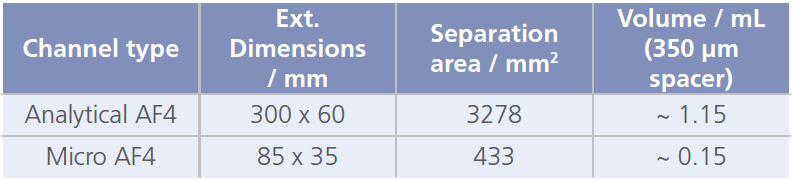
Table 1: Differences of the standard and micro AF4 channel (Approximate values based on trapezoidal channel geometry).
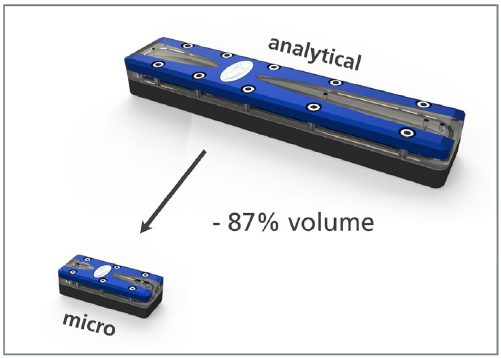
Figure 1: Size and channel volume comparison of the analytical AF4 and the micro AF4 channel.
The smaller separation area in micro AF4 enables the application of reduced cross flow and channel flow rates, and provides:
• Shorter analysis times (~ 30% of analytical)
• Reduced carrier consumption (~ 30% of analytical)
• Lower sample amounts per injection (~ 50% of analytical)
The key question, especially for demanding samples such as LNPs, is whether this miniaturization can be achieved without compromising separation performance.
Materials and Methods
LNP1 and LNP2 were prepared and measured in phosphate-buffered saline (PBS, pH 7.4) as carrier liquid. Samples were diluted to e.g. 0.1–0.2 mg/mL total lipid in carrier liquid prior to injection. Separations were performed on a Postnova AF2000 MT system with a PN3211 UV-Vis detector (λ = 280 nm) and a PN3621 MALS as downstream detectors. Both channels were equipped with the 350 μm spacer and a regenerated cellulose membrane (10 kDa MWCO). All measurements were performed at 25 °C.
Experimental results
Comparable separation of LNP1 in analytical and micro AF4
To compare separation performance and MALS-derived radii of gyration (Rg), two mRNA-containing LNP formulations were analyzed: LNP1 and LNP2, with LNP2 additionally carrying surface-bound targeting proteins.
Figure 2 compares the AF4-MALS fractograms of both LNP samples obtained with the standard analytical channel and the micro channel. Both channel formats resolved a well-defined main LNP population followed by a small late-eluting shoulder consisting of larger particles or minor aggregates. MALS analysis showed comparable Rg distributions across the corresponding peaks. In both channel formats, LNP2 exhibited larger Rg values than LNP1, consistent with the contribution of the surface-bound targeting proteins.
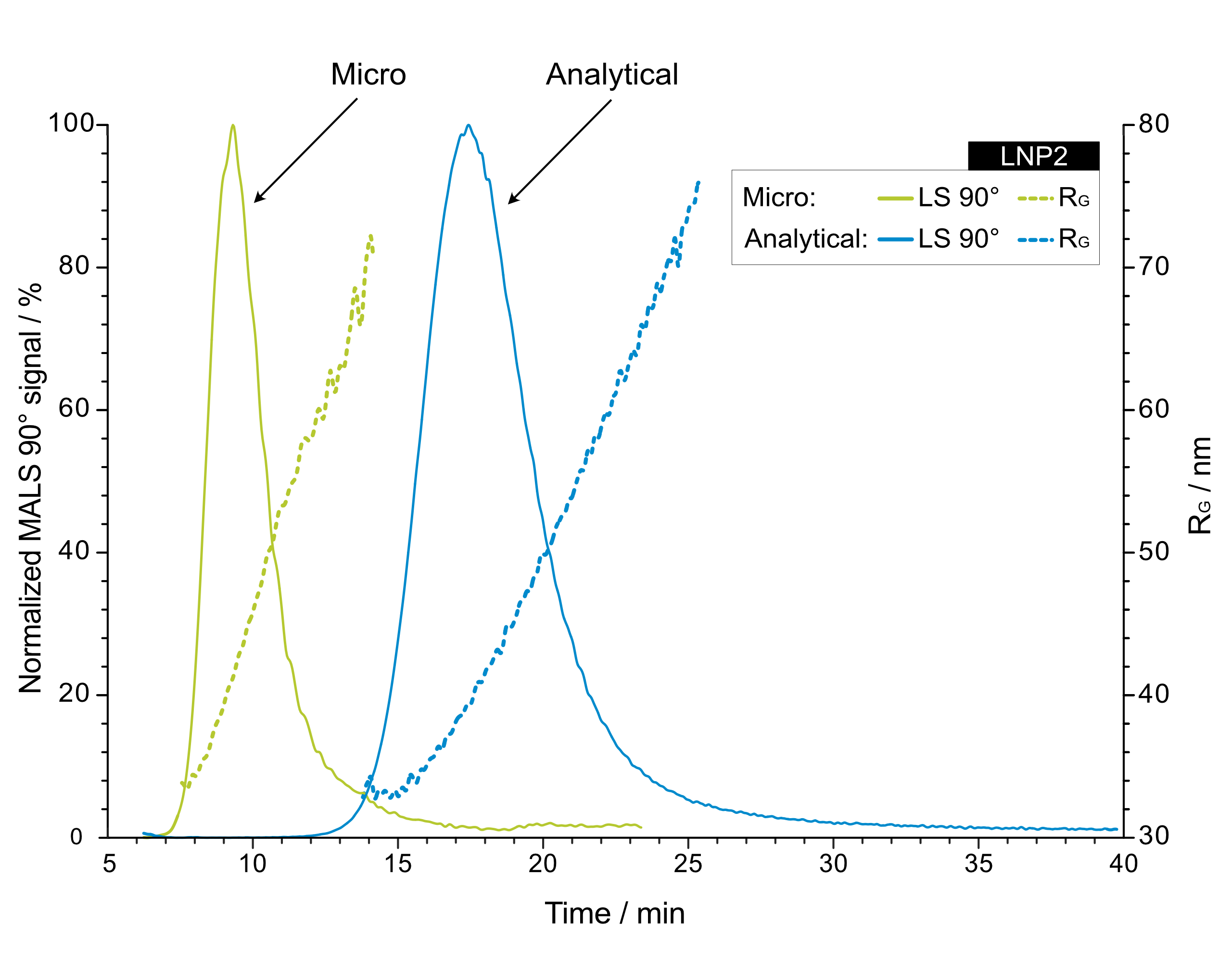
Figure 2: AF4-MALS fractograms of LNP1 and LNP2 obtained using the standard analytical AF4 channel (60 min method) and the micro AF4 channel (20 min method). The solid lines show the MALS signal at a scattering angle of 90°. The dotted lines show the corresponding Rg distribution across the peak.
The established method used with the analytical channel had a total run time of ca. 60 min. For the micro channel, the flow conditions and crossflow decay were adapted to the smaller channel geometry, active separation area respectively, reducing the run time to 20 min and the required sample amount by 50%. Despite this threefold reduction in analysis time, the micro channel reproduced the principal features of the analytical channel fractograms, including the main population, the later eluting shoulder, and the relative size difference between the two formulations (Table 2). Differences in absolute retention time reflect the modified channel geometry and flow conditions. The agreement between the MALS-derived size distributions indicates that no detectable particle-size alteration occurred under the tested micro-channel conditions.
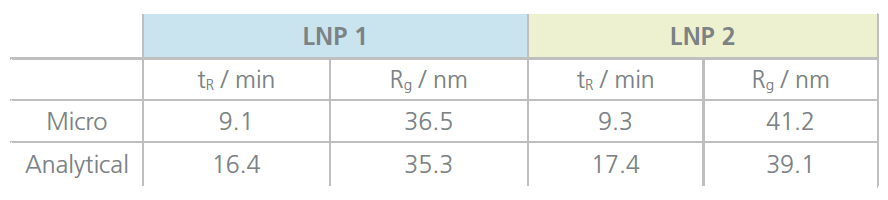
Table 2: Retention times tR and Rg values of the LNP samples determined at the 90° MALS peak maximum.
Conclusion
Using two representative LNP formulations (LNP1 and LNP2), we have shown that the micro AF4 channel can deliver separation profiles and size information comparable to those obtained with the analytical AF4 channel, while reducing total analysis time from 60 min to 20 min and significantly lowering sample and carrier consumption.
This makes the micro AF4 configuration particularly attractive for high-throughput screening of LNP formulations, method development, and situations where sample material or time is limited. The approach can be extended to other nanoparticle-based delivery systems by appropriate adjustment of carrier composition and method parameters.
References
[1] R. Tenchov, R. Bird, A.E. Curtze & Q. Zhou, ACS Nano, 2020, 15, 16982–17015.
[2] J. Parot, F. Caputo, D. Mehn, V.A. Hackley, L. Calzolai, Journal of Controlled Release, 2020, 320, 495-510.
[3] J. Parot, D. Mehn, H. Jankevics, N. Markova, M. Carboni, C. Olaisen, A. Hoel, M. Sigfúsdóttir, F. Meier, R. Drexel, G. Vella, B. McDonagh, T. Hansen, H. Bui, G. Klinkenberg, T. Visnes, S. Gioria, P. Urban-Lopez, A. Prina-Mello, S.E. Borgos, F. Caputo, L. Calzolai, 2024, Journal of Controlled Release, 367, 385-401
[4] D. Müller, S. Cattaneo, F. Meier, R. Welz and A.J. de Mello, Frontiers in Chemistry, 2015, 3:45.